
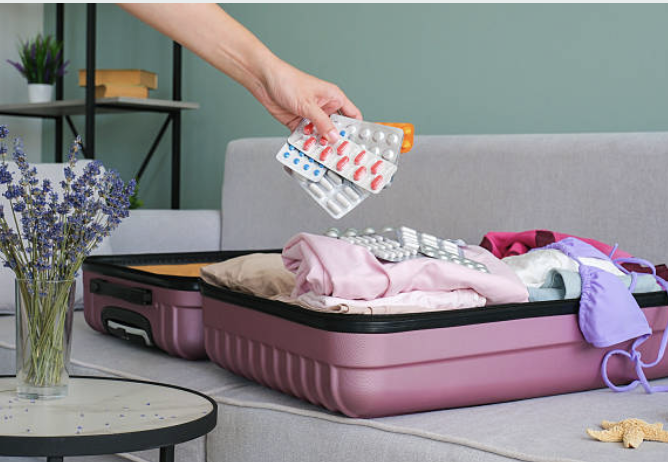
You have a trip booked. Four things are bothering you.
Does this have to stay cold, and for how long. Is security going to take it. Do you move your shot day when you are seven hours off your usual clock. And what if the whole plan falls apart and you just miss a dose.
I get those four every spring as people start booking, then again in November, almost always in that order. So I will take them in that order. Then the parts nobody asks about, which are, naturally, the parts that wreck the week.
Does it have to stay cold, and for how long
Everything in this class lives in the refrigerator, 36 to 46 degrees Fahrenheit, until you start using it.
That is where most people stop reading. Which is how you end up with somebody at a pharmacy counter in June trying to work out how to hold a pen at 40 degrees through an eleven hour flight. You usually do not have to.
The pens have room temperature windows, generous enough to cover almost any normal trip. Zepbound and Mounjaro single-dose pens and single-dose vials can sit at room temperature up to 86 degrees Fahrenheit (30 Celsius) for up to 21 days, with one catch: once a pen has been at room temperature, it does not go back in the refrigerator. The Wegovy single-dose pen can be kept between 46 and 86 degrees for up to 28 days. Ozempic, once used the first time, gets 56 days either refrigerated or at 59 to 86 degrees, and that clock starts at first use and never resets.
Read your own carton. Literally, box in hand, before you pack.
Those windows differ by product and even between pen formats sold under one brand name, and labels get revised. Trust the packaging over a number from an article written by someone who cannot see your box. And if a pen sat somewhere hot, or you cannot reconstruct how long it was out, call a pharmacist. Guessing is how people inject water.
The ceiling matters more than the refrigerator. Above 86 degrees the peptide starts to degrade, and a cooked pen looks exactly like a good one. No cloudiness, no smell, nothing.
It is almost never the hotel room that gets people. It is the rental car in a parking lot in July. The beach bag at two in the afternoon. Keep the pen in its carton, out of the sun, buried in the middle of your bag.
Never freeze any of these, including by improvised cooling. A pen that has frozen gets discarded even if it thawed and looks perfect, so hotel ice is out, and I am lukewarm on minibar refrigerators, which have no thermostat you can trust. For a cruise, use a medical travel case with the gel pack beside the carton.
One rule outranks everything above: the medication goes in your carry-on. Cargo holds swing from freezing to broiling, and checked bags get sent to the wrong continent. I have had patients lose most of a month's supply to a mishandled suitcase, and none of them ever did it twice.
Will security take it
No.
Medications, pens, needles and syringes all go through US airport security in a carry-on. No special container. And you are not doing anything that requires the apologetic voice people use at checkpoints. Declare them, keep the carton somewhere an officer can reach without unpacking your socks, and give yourself an extra minute.
Cooling supplies are allowed too. Frozen or partially melted gel packs are permitted when they are keeping a medication cold, as are medically necessary liquids above the usual 3.4 ounce limit. Both get extra screening, which means someone swabs something while you stand there in your socks.
A pharmacy label on the carton is not legally required. Bring one anyway. Nothing shortens a checkpoint conversation faster than a box with your name on it, and the same is true of a short letter from your prescriber, which you will probably never show anyone and will be glad to have once. Ask for it at a routine visit, not the week of the flight.
International travel is where I want you doing real homework. Some countries require advance paperwork for prescription injectables, and the quantity you may carry varies by destination. Check the embassy or customs site for the country you are entering before you fly, not after you land. Those rules are specific enough that I will not summarize them here.
Do you have to change your shot day in a new time zone
A week is a week in elapsed hours. Your pen cannot read a clock.
So keep the dose at the same absolute moment and let the local time land where it lands. Sunday morning in Boston is Sunday afternoon in Rome. Fine. Set the alarm before you leave, in your home time zone, and stop thinking about it.
If the local time is genuinely unworkable, you are allowed to shift the day, within limits. The product guidance for semaglutide says to leave at least 48 hours since your last dose, and for tirzepatide at least 72 hours. Confirm that against your own label or with a pharmacist, because these details get revised. Treat the intervals as a floor, not a target. Shifting from Sunday to Friday once, so the dose falls before a long travel day, is reasonable. Shifting twice in one week because the itinerary changed is how people stack doses closer together than they realize.
One clarification, because these numbers get mixed up constantly. The 48 and 72 hour intervals answer whether you can shift your day, not how late you can still take a dose you already skipped. That is the next question.
"A week is a week in elapsed hours. Your pen cannot read a clock."
What if you miss a dose entirely
It happens, and it is survivable. The windows commonly cited in the product guidance: for semaglutide, take the missed dose within 5 days of when it was due, and for tirzepatide, within 4 days. Past that, skip it and resume your normal schedule on your normal day. Check your own label, since specifics differ by product.
What you do not do is double up. Two doses close together will not put you back on schedule. It will give you a bad night in a hotel bathroom, which is a specific kind of misery I would rather you take my word on. And do not come home and jump a dose level to make up for a lost week.
The honest version is that one missed weekly dose costs you very little. Appetite suppression fades over a few days and you may notice you are hungrier than you have been in months, which is more disorienting than dangerous. Restarting can bring back some of the nausea from your first few weeks, usually milder. If that stretch is a blur now, our guide to the first month on a GLP-1 covers what a reintroduction feels like.
The pills, and the empty stomach rule
Oral semaglutide, meaning the Wegovy pill and Rybelsus at diabetes doses, carries a dosing rule that sounds trivial on paper and turns into a real problem in a hotel. The pill goes down on an empty stomach with a small sip of plain water, and nothing else to eat or drink for about 30 minutes. Not coffee. Not the orange juice. Not the included breakfast you have 40 minutes to eat before the bus leaves.
Now put that on a trip.
The cart reaches your row at exactly the wrong moment. The tour bus leaves at 6:15 and breakfast opens at 6:00. You wake up somewhere your body is convinced it is dinnertime, and you genuinely cannot say whether your stomach counts as empty or not.
What works in practice is making the pill the first physical act of the day, before you are awake enough to negotiate with yourself. Put the bottle and a glass of water on the nightstand the night before. Take it the moment your eyes open, then shower and dress, which spends the 30 minutes for you. On a long flight, take it when you wake in your seat and wave off the first service. Because it is daily rather than weekly, the clock is forgiving: let the dose slide toward local wake-up time over a few mornings instead of defending your home schedule.
Foundayo (orforglipron), approved April 1, 2026, has no food or water restrictions and no refrigeration requirement at all. For travel it is the easiest member of this group by a wide margin, and I will say that plainly, because a daily tablet you can swallow with a croissant and keep in your pocket solves most of this article. What it does not have is history. We are months into real-world prescribing, coverage is still being sorted out, and nobody can tell you what a second year looks like, because nobody has had one.
Pills also trade one set of travel problems for another, which patients considering a switch tend to hear only half of. Nothing to refrigerate, nothing to declare, no gel pack, no sharps. But a daily drug on a disrupted schedule is a missed dose waiting to happen, and missing four in a row does more to your appetite control than skipping one weekly injection. Losing a bottle abroad is also harder to solve than losing a pen, since the pen has an obvious counterpart in most pharmacy systems and a specific tablet strength may not. If you travel constantly and are still choosing a format, that belongs in the decision, and the tradeoffs sit on our pages for Wegovy and Zepbound with the other weight loss medications we cover.
What happens to your stomach on the road
Do not escalate your dose right before a trip.
That is the one patients ignore most, usually because the increase was already on the calendar and pushing it back feels like going backward. It is not. Stomach trouble clusters in the days after a dose increase, which is the worst possible week to be eating food you did not cook, a long way from your own bathroom. Hold where you are. Climb when you get home. Four weeks of delay changes almost nothing about where you finish.
Constipation is what I actually hear about after trips. Not nausea. Constipation, which nobody mentions in the office and everybody mentions in the follow-up.
Long flights, less water than usual, restaurant food, and a schedule with no room for a normal morning, all landing on a drug that already slows the gut down. Fluid and fiber count for more on the road than they do at home. Drink more water on the plane than feels reasonable, and keep something fibrous going even in a country where breakfast is pastry.
If you also take insulin or a sulfonylurea, this part is not optional reading. Shifting meal times across time zones with those on board carries real hypoglycemia risk, and needs a plan made before you fly, not improvised at a gate. Carry fast sugar on your person, not in the overhead bin.
One more, because it comes up more often than you would guess. If you have any procedure scheduled at your destination, including dental work with sedation, the anesthesia team needs to know you are on a GLP-1. Slowed gastric emptying raises aspiration risk under anesthesia, and that belongs in the conversation when the appointment is made, not in the pre-op bay. Eating well while the medication works is its own subject, covered in diet and exercise on a GLP-1.
Alcohol and the vacation food problem
Alcohol hits differently on a suppressed appetite and a slow stomach. Two glasses of wine at a dinner where you ate a third of your plate is not the two glasses you drank a year ago. Most people discover this somewhere between the second and the third.
Slower than your instincts say. And eat something first, even when nothing sounds good.
Then there is the food itself, the part nobody plans for. You booked the tasting menu. The cruise fare covers nine restaurants. Your aunt made the thing your aunt always makes. And you are on a medication that has made large volumes of food physically unpleasant. Forcing your way through is where the vomiting comes from. Order like a person with a smaller stomach: share plates, and stop eating at the point your body says to rather than the point the menu suggests.
If you lose it or run out abroad
Build margin in before you leave. Pack more than the trip requires, ideally one dose beyond what you need, and keep the spare separate so a single lost bag cannot take all of it. Then set up the two things you will want if something goes wrong:
- A photo of the carton, with the pharmacy label showing your name, the drug, the dose and the prescription number
- Your prescriber's office number and your pharmacy's number saved in your phone, not buried in your email
If a pen is lost or destroyed overseas, your first call is your own pharmacy and prescriber, not a local pharmacy counter. These drugs are not freely dispensable in most countries without a local prescription, brand names and pen formats differ between markets, and the same molecule can arrive in a device that doses differently. Do not assume a familiar name on a box means a familiar pen. Some insurers will authorize an early refill for travel if you ask before you leave, an easier call than the one you make from a hotel lobby.
Missing a week will not undo your progress. The uncomfortable part is that interruptions have a way of becoming permanent. Pharmacy claims analyses from Prime Therapeutics found roughly one in three people prescribed a GLP-1 for weight loss were still taking it at one year, and about one in twelve at three years. A ruined vacation supply is a dumb reason to end up inside that number.
Three smaller questions, on the way out the door
Can you take the shot on the plane? Yes. Nothing about altitude or cabin pressure changes the injection, and you are not obligated to do it in a lavatory the size of a phone booth, though most people prefer the privacy. Bring a hard sharps container, or keep the used pen capped in its carton and carry it out. A seat pocket is not sharps disposal.
Will the X-ray machine damage the pen? It will not, and if you would rather not send the carton through the scanner at all, you can ask for a hand inspection instead.
Should you just pause the medication for the trip? The people who ask me this are usually heading somewhere food-centered, and the reasoning is understandable: you want to eat on vacation, and the drug is in the way. My answer is almost always no, for two reasons. Stopping and restarting means re-earning side effects you already paid for once, and week one of a reintroduction is worse than a mildly restricted appetite in Lisbon. The second is the one people underestimate: appetite returns fast and does not wait for your flight home, so the week you meant to take off becomes three. If the medication is genuinely making travel miserable, that is a dose conversation to have before you book, not a reason to stop.
Pack it in your carry-on, read your own carton for the temperature window, hold your dose where it is until you are home, and bring one more dose than you think you need.